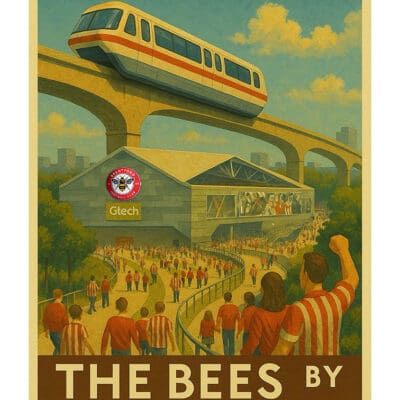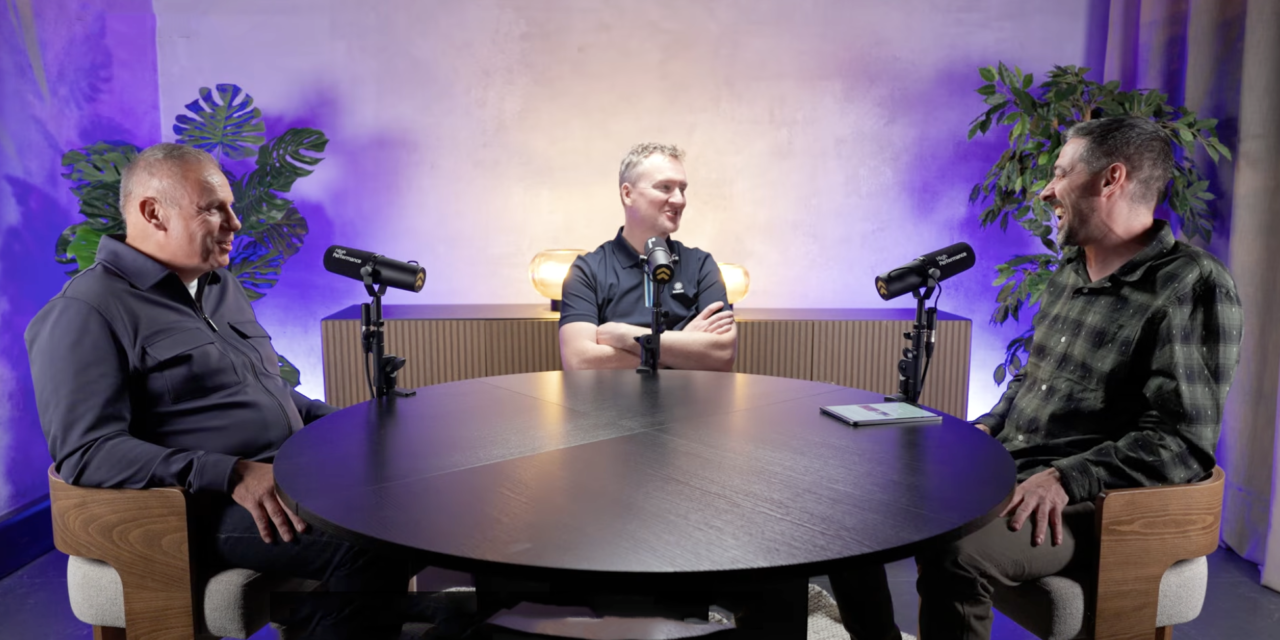
There is a line in the Colin Murray interview with Jon Varney and Phil Giles that I found particularly interesting as a life-long Bee. It came from Phil, talking about why gamblers make good football club owners: “There’s a lot that happens on a football pitch which is completely random and there’s a lot which is signal… you’ve got to try and ignore the randomness and focus only on the signal.” A few minutes later he added the sentence that matters most for those of us who stand, sit and moan at the Gtech every other Saturday: “If you don’t get too emotionally wrapped up in results, you can make better decisions and you’re not thinking about ‘we need to change the manager or the coaches.'”
I listened to the High Performance Business episode in the middle of an international break, more than a week after a Brighton defeat that had half the fanbase muttering about discipline, referees and whether we had gone soft or gone feral. It was exactly the right time to be reminded how the people who run our club think. Because the uncomfortable truth is that most of us, myself included, are the noise.
Start with where we came from, because Varney did. Asked what it was like as a supporter in the old fourth tier, he said the last eight years had been “a lot more enjoyable than that period as a fan”, and that historically, “if you asked anyone about Brentford they’d know that it had a pub on every corner and it probably had the worst play-off record.” It is a line that made me laugh and wince in equal measure, because it is accurate. Anyone who stood at Griffin Park in those days knows that being a Bee was an exercise in managed expectation. We were a club that sat at the wrong end of the league for most of the post-war era. Giles, who followed Newcastle before he ever worked for Brentford, said that when we went up to the Championship in 2014 the hope was modest: “If we can stay in the Championship for a year or two, that would be unbelievably successful.”
That is the context we forget. The expectation did not suddenly rise because we are now a Premier League club with a smart owner. It rose because of what the club did, season after season, to move the goalposts. And it is worth noticing that the people responsible for that rise describe it in strikingly unemotional terms. Giles, reflecting on the 2015 play-off defeat to Middlesbrough, admitted what many would still rather not admit: “I’m not sure it would have been great at that time. If Brentford got promoted, we wouldn’t have been ready for it.” I was gutted that night. I am quite sure I would have been gutted again had we gone up and gone straight back down in 2015, and then gone back to being a club that bobbed between divisions. Instead, the defeat bought time for a model to bed in.
That ‘model’ is the heart of the conversation, and the most interesting thing about it is how little of it, they say, is about data, despite the Moneyball label the media love to attach. Giles was almost dismissive of the idea. “Forget data or how you sign players,” he said. “It was more the identification of that as the key that was going to elevate us to the Premier League.” In other words, the insight was not a spreadsheet, it was a strategy. Brentford in 2015 had some of the lowest revenue in the Championship, so the only way to compete was to buy young, develop them, and sell them well. What gave us the edge, he said, was simply doing it earlier than everyone else: “Now it seems like every club’s got this idea… it’s quite difficult for every club to be net sellers of players. Someone eventually has to be the net buyer.”
I found that very honest, as it admits that the advantage is temporary, and that the work is never done. It also explains why the middle of the process matters as much as the glamorous top flight successes. Varney was emphatic that Giles’s team “do not get enough credit for all the bit that goes on in the middle,” and he used Bryan Mbeumo as the example, signed at eighteen or nineteen and was a very different player by the time he left. That development work is not to be taken for granted. It does not trend on social media every week. But it is why Varney can say, with a straight face, that when fans ask him about the best Brentford team they have ever seen, “it’s always the one we’re putting out this weekend.”
Which brings me back to the noise. If I am honest, my own reaction to a bad result fluctuates wildly. Last week at Brighton, with a man sent off and the game gone inside forty minutes, my first instinct was to blame the referee, then the VAR, then Igor Thiago, and then, inevitably, Keith Andrews. I suspect I am not alone. Giles’s reflections on the appointment of Andrews are a useful corrective. There was no mystery about why he got the job: “There is no someone who isn’t a gamble. There are only gambles in all directions,” Giles said. They felt Keith was at “the lower end of the gamble” because they knew his character, knew he was close to the players, and knew he had already taken the unusual step of joining as a set-piece coach to broaden his experience. “I’d say it was better than 50/50,” Giles added. That is not the language of a man looking for a scapegoat. It is the language of someone who understands variance.
There is another reason the interview resonated with me, and it is the one that Varney made almost in passing. Asked how Brentford got young players to buy into a model where everyone knows the exit door is there, he did not talk about contracts or bonuses. He said: “Our fans get it.” He explained that supporters understand “we’re not owned by a sovereign wealth fund or private equity”, that the club has to run sustainably, and that “there will come a point that we will sell a player on and we will reinvest that money back into the football side.” That is the quiet bargain at the heart of our club. We accept that the best players will leave. In return, we get a club that is not going to be reckless with its future.
It is a bargain I am (personally) happy with, but it is worth being honest that it has limits. Varney was unusually frank about the financial reality, noting that last year’s revenue was around £200 million while “some of our competitors in the league are doing six, seven hundred million.” That gap is the real story of the Premier League, and it is why squad cost ratio rules matter so much to a club like ours. It is also why Giles’s account of the decision to sell both Mbeumo and Yoane Wissa in the same window was so revealing. “That was 39 Premier League goals out of our team,” he said. They did it because it was the right financial call, accepting that it raised the relegation risk, but concluding that “it was still a better decision… even if we got relegated, in a stronger position.” Whether you agree with that is a matter of outlook. I found it sobering because it shows the club is willing to make the unpopular choice for the long term, even if it heightens the risk of going down.
If there was a moment that distilled the outlook of the two men, it was the closing exchange. Asked for one word to hang above the door at Brentford, Varney chose “grow”, Giles “improve”. They are different words, but they point the same way. Giles’s explanation made me smile: “Don’t focus on Europe. Don’t focus on winning a trophy… just focus on improving.” It is the sort of advice every supporter should keep in their back pocket, especially at the end of a season like this one, when we are eighth, still ahead of a lot of fancier clubs, and still prone to losing the plot over one bad result.
None of this means we should stop caring. The passion is the whole point, and I would not want a fanbase that shrugged at defeat. But the interview offered something rarer than reassurance: a reminder that the people steering this club are not swayed by the swings in mood that dominate our WhatsApp groups. They are trying to read the signal. We would be wise to try to do the same. Or maybe do so a little more often if never at all.
Tim Street and I were fortunate to be given access to every Brentford manager and director of football, not to mention an interview with owner Matthew Benham himself, when writing our book, The Brentford Revolution. It dives even deeper into every twist and turn of the Bees’ rise from the basement to the top tier, and I can tell you that the themes in this interview, the patience, the honesty and the refusal to be swayed by the noise, run right through the story. But listening to Varney and Giles this week serves as a timely reminder of what a remarkable story we are not just witnessing, but revelling in.
We have come a very long way from just a pub on every corner. The trick, as ever, is not to mistake a bad afternoon on the south coast for a terminal change in direction or fortunes.
Dave Lane