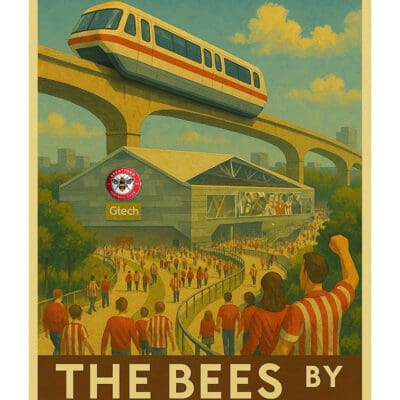
Brentford’s rise from the bottom half of the Football League to the Premier League in what looks, from the outside, like no time at all, has become one of those stories other clubs’ fans bring up down the pub a lot, usually followed by some version of “how did you actually do that?” The honest answer is that it didn’t happen overnight at all – it happened over thirteen years of decisions, most of them painful at the time, that have culminated in one of the best stories in the modern game.
Laney’s book, The Brentford Revolution, tells the whole story in incredible detail, with every twist and turn covered, and he’s spoken about it every week on this podcast too, which make fascinating listening. Beesotted have gone back through more than 1,300 podcasts to pull together the ones that actually tell that story properly. So, Billy “The Bee” Grant and Dave “Laney” Lane sat down for the latest instalment of Beesotted Reloaded to talk through it, and it’s worth hearing in full – here’s what’s in store.
It starts, fittingly, with the worst day. April 2013, the final game of the season at home to Doncaster, Uwe Rösler in the dugout, and automatic promotion to the Championship there for the taking with a win. Nil-nil deep into injury time, and then a penalty – the kind of moment, as Laney put it, where “you can’t write it.” Marcello Trotta stepped up, the ball cannoned back off the bar, and before anyone in the ground had processed what hadn’t happened, Doncaster were breaking at the other end to score the goal that won them the title. “Half the team were lying still around the penalty area at the other end of the pitch, like they’d been shot,” Laney remembered – and emotionally, that’s exactly what had happened to them.
A play-off defeat to Yeovil followed, by which point the whole thing had tipped from heartbreak into something closer to trauma. And yet, looking back now, both hosts agree it was probably the best thing that could have happened. Brentford regrouped, went up automatically the following season anyway, and arrived in the Championship better equipped to survive than they would have been twelve months earlier. It’s a theme that runs through the entire story: the knockback that, with time, turns out to have been necessary.
Rösler gets real credit here as the manager who first tried to drag Brentford’s football up by the roots – “pass them to death” was his own phrase for it, even when, in the early days, the squad simply didn’t have the players to execute what he wanted and games got ugly before they got good. He left for Wigan the same summer the club’s long-running hunt for a new stadium finally produced something concrete – Hounslow Council’s approval for the Lionel Road site, broadcast live by Beesotted on what Laney called “a very proud night,” even if nobody quite grasped at the time how much of what followed would depend on it. Without the move away from Griffin Park, there’s no hosting Chelsea or Liverpool in the Premier League on a wet Friday/Saturday/Sunday/Monday night – the new stadium provides the footing everything else has been built on.
What came next was Mark Warburton, promoted from an under-the-radar director of football role into the manager’s chair, and it worked – spectacularly, for a while. Promotion was sealed in 2013/14 when Preston came to Griffin Park, and an Alan Judge penalty on Good Friday remains one of those results fans will never forget. Brentford went into the following Championship campaign flying, sixth at Christmas, beating Leeds away from home in a performance that had supporters singing Warburton’s name on the train home convinced nothing could stop them. And then, in February, it did – news broke that Matthew Benham and Warburton were parting ways, mid-season, with the team still pushing for the play-offs.
It made no sense from the outside, and talk radio tore into the decision at the time; Adrian Durham’s rant on TalkSport was typical of the reaction. But the split wasn’t really about results. Benham wanted a more data-driven, sustainable model built around recruitment and development rather than one manager’s instincts, however good those instincts were, and Warburton – by his own account, in an exclusive Beesotted interview recorded within days of the announcement – wanted to keep doing things the way that had got them there. Something had to give, and Brentford, characteristically, chose the long game over the short one.
The uncomfortable truth about that period is that it didn’t immediately work. A brief, mismatched spell under Marinus Dijkhuizen gave way to Dean Smith’s calmer, more unifying presence, and it was around this time that Beesotted secured one of the more revealing conversations in the whole archive – a two-hour sit-down with Benham himself at Smartodds, at a point when fans and press alike had decided he’d lost the plot. He hadn’t. What came out instead was an owner openly admitting the post-Warburton transition had been mishandled in places – recruitment had been off, the squad restructuring too abrupt – while holding firmly to the underlying idea that data and traditional scouting needed to work together, not in competition. Listening back now, knowing what Brentford’s recruitment department has since become, it’s genuinely startling how much of the modern club was already mapped out in that room in 2016, years before any of it had actually paid off.
That same period produced the decision that probably generated more anger among a section of our supporters than any other: closing the Academy. The reasoning was blunt and financial – the club was losing upwards of £2 million a year running it, and bigger clubs kept picking off 15- and 16-year-olds for compensation fees so small they were, in Billy’s words, “chicken feed.” Ian Poveda left for Manchester City and Josh Bohui for Manchester United, both for around £30,000 apiece, and both moves convinced the Brentford decision makers that the system simply didn’t work for a club Brentford’s size at that time.
What replaced it was the B Team, built around the late Rob Rowan’s vision of signing players old enough to have already chosen Brentford rather than developing children who might be poached at seventeen. Josh Dasilva, who turned down Arsenal to join, became the proof the model could work – and the project was successful enough that, once promotion to the Premier League made it financially sustainable again, the Academy itself was eventually reopened.
Thomas Frank’s arrival barely needs introducing to anyone reading this, but it’s worth remembering how shaky the start actually was – one win from his first ten league games, a solitary victory against Millwall. Benham, by his own account at the time, stayed calm because the underlying numbers said the performances were right even when the results weren’t – “no knee-jerkery,” as Billy put it. Frank himself, in Beesotted’s own “Frank Talking” sessions recorded down a pub in Barnes, was disarmingly honest about how long it took him to trust the club’s model over his own gut instinct, and how he came to see a failed signing as a reason to understand what had gone wrong rather than proof the whole approach was flawed.
Every piece of that – the trust, the patience, the willingness to be publicly wrong and quietly correct it – is the actual thread of this entire Brentford story, far more than any single transfer or result. Doncaster, Warburton’s exit, the Academy closure, Frank’s rocky start, losing in the play-off final to Fulham: none of them look, at the time, like steps towards the Premier League. Looked at together, they’re the only reason Brentford got there at all… and more importantly, how they’ve survived.
All eleven Beesotted Reloaded episodes are up now, click on the links above or head over to fond out more on beesotted.com or www.PrideofWest.London, in audio and video form.